


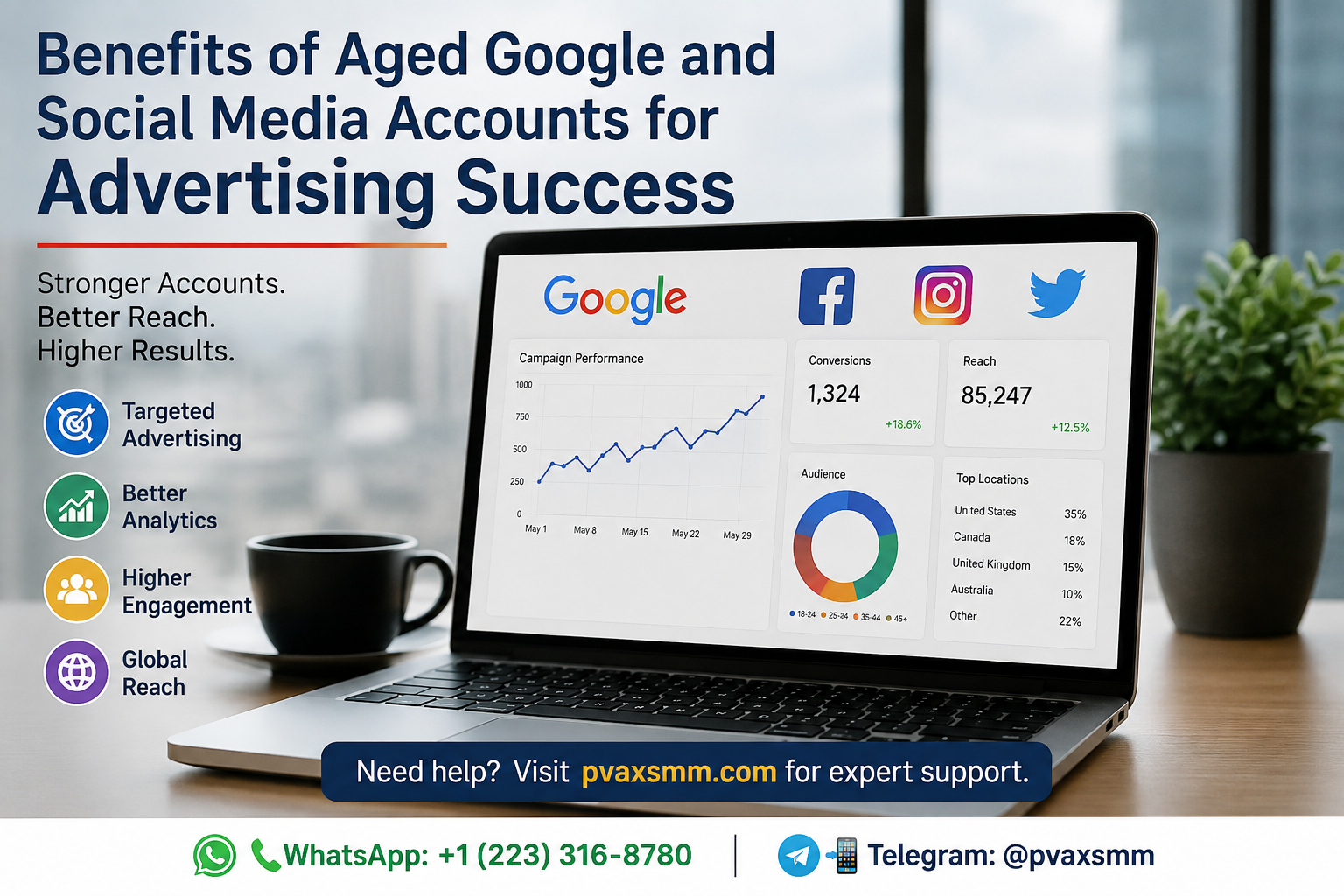
Advertisers don’t trust every account equally. An aged Google Ads account with three years of clean billing history, real conversion data, and no policy strikes behaves differently than one that was created yesterday.
The same is true on social platforms. A Facebook Page with a genuine posting history and real follower engagement carries more weight, both with audiences and with the platform’s own algorithms, than a blank profile with zero activity.
This article looks at why account history matters, what an Aged, self-owned advertising presence can realistically offer a business, and where the limits of that advantage are. It’s written for marketers, agency owners, and business owners who want to understand this topic clearly, not for anyone looking for shortcuts around platform rules.
One thing to be clear about upfront: this article is about accounts a business builds and controls itself over time. Buying, renting, or transferring Google or social media accounts violates the terms of service of Google, Meta, and virtually every major ad platform, and it can result in permanent suspension. Nothing here should be read as advice to acquire accounts from a third party.
Aged vs. New Accounts: A Practical Comparison
Let’s compare two realistic scenarios: a business launching a brand-new Google Ads and Facebook Page setup versus a business advertising through accounts it has run for several years.
New accounts typically involve:
- A “learning phase” while the platform’s algorithm gathers performance data
- No historical conversion data to inform bidding or audience targeting
- A smaller, unproven audience base
- Extra scrutiny during initial ad review, which is standard for new advertisers
Aged accounts typically offer:
- Existing conversion history that platforms can use for smarter automated bidding
- A built-in audience with some prior engagement or purchase behavior
- Billing and account history that reduces certain manual review friction
- Prior campaign data that shows what messaging and creative already worked
None of this means new accounts can’t succeed. Plenty of businesses launch strong campaigns from day one. But it does mean that time and consistent, policy-compliant use build up real, usable signals — for the platform and for the marketer.
Enhanced Brand Awareness
Consistency is what builds recognition, not novelty. A business that has advertised steadily on Google Search and Meta platforms for a year or more has simply had more chances for its name, logo, and message to register with potential customers.
Repetition across search results, social feeds, and remarketing placements reinforces recall. That’s a well-Aged principle in marketing, not something unique to any one platform.
An Aged presence also means more owned content exists: past posts, reviews, testimonials, and search results tied to the brand. That accumulated footprint gives new visitors more to find when they look the business up.
Increased Customer Engagement
A social media profile with an ongoing history of posts and replies gives potential customers something to interact with beyond a single ad. People can scroll back, see how the business responds to comments, and judge whether it’s active and responsive.
This matters because engagement is a two-way signal. Platforms like Meta and LinkedIn factor engagement into how widely content is shown organically, and users are more likely to comment on or share content from a brand that already looks active.
Practical ways Aged accounts support this:
- A visible history of customer questions being answered
- Ongoing conversations in comment threads
- Consistent posting that keeps the account in followers’ feeds
- Community-building through polls, Q&As, and user-generated content
Improved Customer Insights
The longer an account has run real campaigns, the more first-party data it accumulates: which audiences converted, which creative underperformed, which landing pages held attention.
This is one of the more concrete, verifiable advantages of an Aged account. Google Ads and Meta Ads Manager both retain historical performance data that newer accounts simply don’t have yet.
Marketers can use this history to:
- Identify which customer segments have the highest lifetime value
- Refine audience targeting based on actual past conversions
- Spot seasonal patterns in demand
- Build lookalike or similar audiences from real customer data, in line with each platform’s privacy rules
Cost-Effective Marketing Strategy
Aged accounts can shorten setup time. There’s no need to rebuild audience lists, re-test every creative from zero, or wait through an extended learning phase before automated bidding has enough data to work efficiently.
That said, it’s important to be precise here: account age itself does not lower advertising costs. Auction-based systems like Google Ads and Meta Ads price placements based on competition, relevance, and bid strategy — not how old the advertiser’s account is.
What actually improves cost efficiency is having historical data to act on: knowing which audiences convert, which ad copy performs, and which budgets have historically produced acceptable returns. An Aged account simply gives a marketer more of that data to work with sooner.
Enhanced Customer Loyalty
Loyalty is built through consistent experience, not account age by itself. But Aged accounts do make consistency easier to demonstrate.
Customers can see a business’s history of communication, look back at how issues were handled publicly, and judge reliability based on a real track record. That’s harder to fake and harder to build overnight.
Factors that genuinely drive loyalty include:
- Fast, helpful responses to customer questions
- Useful, non-promotional content mixed in with offers
- Reliable follow-through on promises made in ads
- Recognizable, consistent branding across every touchpoint
Improved Search Engine Ranking
This deserves a direct, honest answer: simply having an old Google Ads or Google Business Profile account does not improve organic Google Search rankings. Search ranking and ad account history are separate systems.
What does influence search visibility over time includes:
- Consistent publication of relevant, well-structured content
- Earned backlinks from credible, relevant sites
- A stable, positive review history on Google Business Profile
- Clear technical SEO fundamentals (site speed, mobile usability, structured data)
- Brand search volume, which can build gradually as awareness grows
An Aged online presence can indirectly support SEO because a business with a longer history has typically had more time to earn backlinks, publish content, and collect reviews. But that’s a byproduct of sustained effort, not a direct effect of account age.
Better Customer Satisfaction
Response time and reliability are two of the biggest drivers of satisfaction in digital customer service, and both are easier to deliver through an Aged communication channel that customers already know how to find.
A business with a well-known social media presence gives customers a familiar place to ask questions, report issues, or leave feedback. That reduces friction compared to hunting for a generic contact form.
Increased Sales and Conversions
Sales don’t come from account history alone. They come from the combination of awareness, targeting accuracy, a compelling offer, a working landing page, and a smooth checkout or lead-capture process.
An Aged account contributes supporting pieces to that chain: more audience data for targeting, more creative testing history, and (where applicable) trust signals like reviews and follower counts that can influence a buyer’s decision at the margin.
Social Media Advertising Statistics
A few data points are worth noting here, with sources so you can verify them before citing them elsewhere — advertising benchmarks shift often, and figures vary by methodology.
- Meta’s Family of Apps reported advertising revenue of roughly $196 billion for full-year 2025, according to Meta’s own financial disclosures reported by industry trackers, making it the second-largest digital ad platform behind Alphabet.
- According to WordStream’s 2025 Facebook Ads Benchmarks report, which analyzed over 1,000 campaigns, average Facebook cost-per-click for traffic and lead campaigns declined year-over-year compared with 2024.
- HubSpot’s 2025 State of Marketing Report found that roughly 40% of surveyed marketers named Facebook as one of the top drivers of ROI on their teams, though HubSpot’s 2026 report shifted that top spot to Instagram.
- YouTube advertising revenue reportedly reached over $40 billion in 2025, based on Alphabet’s reported earnings, reflecting continued growth in video ad spend.
Because these figures come from third-party aggregators summarizing platform and analyst reports, verify them against Meta’s, Alphabet’s, WordStream’s, or HubSpot’s original published reports before using them in client-facing material.
Increased Reach and Global Audience
Both Google Ads and major social platforms let businesses target by country, language, and region from a single account. This is standard functionality, not something exclusive to Aged accounts.
What an Aged presence adds is prior performance data by geography — which markets have historically converted, and at what cost — which can inform smarter expansion decisions.
Targeted Advertising for Better ROI
Modern ad platforms support several targeting layers:
- Demographic targeting (age, location, language)
- Interest and behavioral targeting, based on platform activity
- Remarketing, showing ads to people who already visited a site or app
- Lookalike or similar audiences, built from existing customer lists
- Keyword targeting on search platforms, matched to buyer intent
An account with real conversion history can build more accurate remarketing and lookalike audiences, since the underlying data reflects actual past customers rather than assumptions. That’s a genuine efficiency gain, though it depends entirely on data quality, not account age in isolation.
Real-Time Data and Analytics
Google Ads and Meta Ads Manager both report performance close to real time: impressions, clicks, conversions, cost per result, and return on ad spend. This lets marketers adjust budgets and creative mid-campaign rather than waiting for a post-mortem.
Aged accounts benefit here mainly through comparison: current performance can be measured against historical benchmarks specific to that business, which is more useful than relying on industry averages alone.
Personalized Customer Experience
Segmentation and retargeting let businesses show different messaging to different audience groups, based on behavior like past purchases, site visits, or content engagement.
This works best with a reasonable volume of historical data, which Aged accounts naturally have more of. New accounts can still segment audiences; they just have less behavioral history to segment with, at least initially.
Generate Leads
Practical lead-generation tactics that apply regardless of account age include:
- Running Google Search ads targeted to high-intent keywords
- Using Meta or LinkedIn lead forms to reduce friction for mobile users
- Building dedicated landing pages matched to each ad’s message
- Offering a clear, specific call to action
- Following up quickly once a lead is captured
Going Viral
No legitimate advertising strategy can guarantee virality. Content that spreads widely tends to share a few traits: strong emotional resonance, easy shareability, good timing, and a format native to the platform it’s posted on.
Aged accounts have one structural advantage here: existing followers who can act as an initial distribution base. But virality itself remains unpredictable and cannot be manufactured on demand through legitimate means.
Gauging Sentiment Around Your Brand
Businesses can track how people feel about their brand through:
- Comment tone and volume on social posts
- Star ratings and written reviews on Google Business Profile
- Direct mentions across social platforms (social listening)
- Post-purchase surveys and NPS scores
An Aged account provides a longer history to analyze sentiment trends over time, which is harder to do with a newly created profile that has little activity to reference.
Low-Cost Advertising
Cost efficiency comes from testing and optimization, not from account age. Businesses that consistently improve efficiency tend to:
- Test multiple ad creatives against each other
- Refine audience targeting based on conversion data
- Reallocate budget toward top-performing campaigns
- Pair paid ads with organic content to reduce total acquisition cost
An Aged account can apply these practices faster because it already has historical performance to learn from — but the discipline of testing and optimizing is what actually lowers cost, not the account’s age.
In-Depth Analytics: Key Metrics to Track
| Metric | What It Measures | Why It Matters |
| CTR (Click-Through Rate) | Percentage of viewers who click an ad | Indicates ad relevance and creative appeal |
| CPC (Cost Per Click) | Average cost paid per click | Helps manage budget efficiency |
| CPM (Cost Per Mille) | Cost per 1,000 impressions | Useful for awareness-focused campaigns |
| CPA (Cost Per Acquisition) | Cost to generate one conversion | Core efficiency metric for lead/sales campaigns |
| Conversion Rate | Percentage of clicks that convert | Reflects landing page and offer effectiveness |
| ROAS (Return on Ad Spend) | Revenue generated per dollar spent | Direct measure of campaign profitability |
| Customer Acquisition Cost (CAC) | Total cost to acquire one customer | Broader than CPA; includes all marketing spend |
| Customer Lifetime Value (CLV) | Projected total value of a customer | Helps justify acceptable acquisition costs |
| Engagement Rate | Interactions relative to reach or followers | Signals content resonance and community health |
Innovation and Collaboration
The strongest advertising results tend to come from collaboration across teams, not from any single platform account. Marketing, sales, analytics, and customer support teams that share data tend to make faster, better-informed decisions.
Integrating a CRM with ad platform data, for instance, lets a business track leads from first click through to closed sale, which is far more useful than looking at ad platform metrics in isolation.
Get Faster Results Than SEO — But Not a Replacement For It
Paid advertising can generate visibility and traffic almost immediately after a campaign launches. Organic SEO, by contrast, typically takes months to build meaningful rankings, since it depends on accumulated content, backlinks, and trust signals.
That speed makes paid ads useful for testing offers, launching new products, or filling short-term pipeline gaps. It doesn’t replace SEO’s long-term value: once built, organic rankings tend to generate traffic without ongoing per-click cost, which paid ads never fully replicate.
Most sustainable marketing strategies use both together, rather than treating one as a substitute for the other.
Aged vs. New Accounts: Key Comparison
| Factor | Aged Account | New Account |
| Setup Time | Minimal, infrastructure already exists | Requires full setup and audience building |
| Historical Data | Available, informs targeting and bidding | None initially |
| Audience History | Existing engaged followers/customers | Must be built from scratch |
| Brand Presence | Aged, more content and reviews | Limited, growing over time |
| Campaign Preparation | Faster, using past creative performance | Requires initial testing phase |
| Trust Considerations | Built through consistent, compliant use | Earned gradually through activity |
| Analytics Availability | Rich historical benchmarks | Limited until data accumulates |
| Compliance Requirements | Same as any account; ongoing diligence needed | Same as any account from day one |
| Potential Benefits | Faster optimization, richer data, audience reach | Full control from inception, clean history |
| Potential Risks | Complacency, outdated practices if unmanaged | Learning-phase costs, slower initial results |
How to Use Aged Accounts Responsibly
For businesses that legitimately own and operate long-standing Google or social media accounts, a few practices protect that asset and keep it compliant:
- Enable two-factor authentication on every advertising and business account.
- Keep ownership documentation current, including verified business information on Google Business Profile and Meta Business Manager.
- Maintain consistent business information (name, address, phone number) across all platforms.
- Review advertising policies regularly, since platforms update them frequently.
- Protect data privacy, following applicable regulations like GDPR or CCPA when handling customer data.
- Avoid suspicious login or access patterns, such as sharing credentials across many unrelated users or devices.
- Keep audience engagement authentic, avoiding purchased followers, fake reviews, or bot engagement, all of which violate platform policies and can trigger account penalties.
Common Mistakes to Avoid
- Buying or acquiring accounts from third parties. This violates platform terms and risks permanent suspension.
- Using accounts without documented authorization, such as running ads through someone else’s business account without a clear agreement.
- Ignoring platform advertising policies, which change often and vary by industry.
- Using fake followers or engagement, which damages long-term account credibility and can trigger enforcement action.
- Over-targeting audiences so narrowly that campaigns can’t gather enough data to optimize.
- Ignoring analytics and continuing to run underperforming campaigns without adjustment.
- Sending traffic to poor landing pages that don’t match the ad’s message or load slowly on mobile.
- Advertising too frequently to the same audience, which causes fatigue and rising costs.
- Making unrealistic claims in ad copy, which risks both platform rejection and consumer trust issues.
Frequently Asked Questions
What is an aged Google account? The term generally refers to a Google account that has existed and been used for an extended period. Legitimately, this simply describes a business’s own long-standing account; it should never be acquired from a third party, which violates Google’s terms of service.
What is an aged social media account? Similarly, this describes a social media profile with a long, genuine history of activity, owned and operated by the same entity since creation — not a profile obtained through purchase or transfer, which most platforms prohibit.
Are aged accounts better for advertising? An account with a longer, genuine history often has more performance data and audience insight to work with, which can support faster optimization. Account age alone doesn’t guarantee better results; strategy, targeting, and creative quality matter more.
Do aged accounts improve Google Ads performance? Not directly. Google Ads’ auction system prices placements based on relevance, bid, and competition, not account age. Historical conversion data can improve automated bidding, but that comes from consistent, compliant use over time, not age itself.
Can an Aged social media account increase advertising reach? It can help, since an existing follower base and content history give campaigns a stronger starting point. Reach still depends heavily on targeting, budget, and content quality.
Are Aged accounts safe to use for marketing? Yes, as long as they are legitimately owned, properly secured, and used in compliance with each platform’s advertising policies. Accounts obtained through unauthorized means carry real risk of suspension.
What’s the difference between an aged account and an Aged business account? “Aged account” is often used loosely or, in some contexts, refers to accounts sold by third parties. “Aged business account” describes a business’s own account with a genuine operational history, which is the only version consistent with platform terms.
How can businesses improve advertising ROI? Through consistent audience testing, accurate conversion tracking, strong landing pages, clear offers, and ongoing analysis of performance data across CTR, CPA, and ROAS.
Can Aged accounts improve SEO rankings? Not directly. SEO rankings depend on content quality, backlinks, technical performance, and user experience signals, which are separate systems from ad account history.
What should businesses consider before using an Aged advertising account? Confirm clear, documented ownership; review the account’s compliance history; ensure security measures like two-factor authentication are active; and verify all business information is accurate and current.
Conclusion
An Aged Google or social media presence offers real, practical advantages: more performance data, a built-in audience, and a track record that supports faster, better-informed decisions. Those benefits come from consistent, legitimate use over time, not from account age alone.
Advertising success ultimately depends on the fundamentals: accurate targeting, strong creative, functional landing pages, honest claims, and ongoing analysis of real performance data. Account history can support that work, but it doesn’t replace it, and it should always be built and maintained in line with each platform’s policies.


1 Comment
[…] Better advertising performance […]