In today’s digital age, having a reliable and secure online presence is crucial for businesses of all sizes. One way to achieve this is by creating an account with a Payment Verification Authority (PVA) or a non-PVA provider. But what exactly are these accounts, and how do they differ from each other? In this blog post, we will explore PVA vs non-PVA accounts and help you determine which one is right for your business in 2026.
What PVA Actually Means
PVA usually stands for Phone Verified Account.
In online account marketplaces, the term generally describes an account for which a phone number was used during account verification. Exact verification requirements vary by platform, and “PVA” is not a universal technical certification.
This distinction is important because phone verification does not mean an account is automatically trusted, established, secure, or compliant.
For example, phone verification generally does not prove:
- How long the account has existed
- Who created it
- Whether the current user is the legitimate owner
- Whether the account has a strong reputation
- Whether the account will avoid future security checks
- Whether the account complies with a platform’s policies
A phone number can be one security or verification signal among many.
Why does phone verification matter?
Platforms use phone verification for several reasons, including:
- Reducing automated abuse
- Detecting suspicious registration patterns
- Helping users recover accounts
- Adding an authentication factor
- Increasing confidence that an account is associated with a reachable phone number
However, the exact role of phone verification differs from one service to another.
Therefore, PVA should be understood as a description of a verification event, not a guarantee of account quality.
What “Non-PVA” Usually Means
A non-PVA account generally refers to an account that has not undergone phone verification, at least according to the terminology used by online sellers.
That does not necessarily mean the account is unsafe or low quality.
A legitimate user can create an account and use it normally without needing a phone number at every stage. Conversely, some services may require phone verification depending on their security systems, risk signals, or account activity.
This creates an important distinction:
Non-PVA does not automatically mean untrusted, and PVA does not automatically mean trusted.
The actual requirements depend on the platform.
For legitimate users, the appropriate approach is to follow the service’s current verification and security requirements instead of trying to optimize an account around marketplace labels.
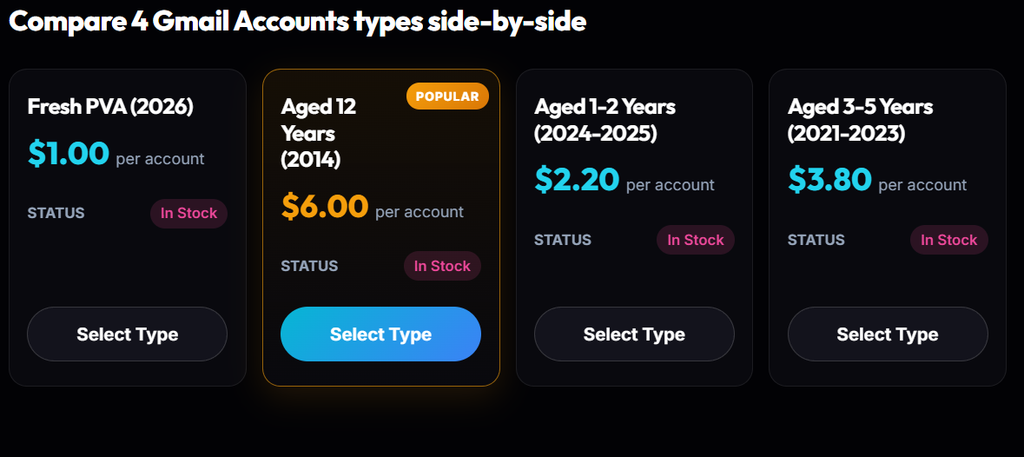
Why PVA Accounts Cost 3–10× More
Some third-party marketplaces charge substantially more for accounts advertised as PVA.
Why?
The pricing usually reflects the seller’s perception that phone-verified accounts have greater demand or additional characteristics.
Several factors may influence marketplace pricing:
1. Verification demand
Some users believe phone-verified accounts are more useful because verification may be required for particular platform features.
2. Phone-number availability
Phone verification can require access to a suitable phone number and a verification process. Sellers may therefore claim that verified accounts require additional resources.
3. Perceived account value
Marketplace sellers often assign higher prices to accounts they believe have additional verification or historical characteristics.
4. Scarcity
If a particular type of account is difficult to obtain legitimately, sellers may charge more.
5. Marketplace marketing
Terms such as “PVA,” “aged,” “premium,” and “high quality” can also be used as marketing labels.
However, there is no universal rule that a PVA account should cost three, five, or ten times more than a non-PVA account.
Prices vary widely, and a higher price does not establish authenticity or security.
A buyer should therefore avoid assuming:
Higher price = higher trust.
That equation does not reliably hold.
What PVA Gets You in Practice
The practical benefit of phone verification depends entirely on the platform and its requirements.
In some situations, verification may provide an additional security or identity signal. It may also allow a user to complete a registration or security step that requires a phone number.
But PVA status alone does not necessarily provide:
- Higher search rankings
- Better advertising performance
- Guaranteed account approval
- Immunity from suspension
- Higher reputation
- Guaranteed access
- Guaranteed recovery
- Protection against future verification requests
This is particularly important for people evaluating accounts for marketing, advertising, social media, or other commercial purposes.
A verified account can still be suspended if its user violates platform rules.
Similarly, a verified account can still be compromised if its password, recovery information, or authentication methods are poorly managed.
PVA is a security attribute—not a reputation guarantee
Think of phone verification as one piece of an account’s security profile.
Other factors can include:
- Password security
- Multi-factor authentication
- Recovery information
- Account ownership
- Login behavior
- Platform compliance
- Payment information
- Business verification
- User activity
The combination matters much more than the PVA label alone.
When Non-PVA Is the Right Choice
For legitimate users, a non-PVA account can be perfectly appropriate when the platform does not require phone verification.
Consider someone creating an account for:
- Personal communication
- Education
- Professional correspondence
- Project management
- Testing
- A legitimate business workflow
- A community that does not require phone verification
If the platform permits the account to operate without a phone number, there may be no reason to pursue PVA status simply because it sounds more valuable.
Avoid unnecessary verification
Users should also consider privacy.
Providing a phone number to an online service can create an additional association between the user and the account. Depending on the platform’s privacy practices, this information may be used for security, recovery, or other legitimate operational purposes.
The best choice is therefore not automatically “PVA.”
The best choice is:
Use the verification method required by the service and appropriate for your legitimate purpose.
How to Verify an Account Is Actually PVA
This section deserves caution because there is no universal public method for independently proving that a third-party account was previously phone-verified.
The meaning of “PVA” can also differ between sellers and platforms.
If you are evaluating an account you legitimately own or administer, check the platform’s own account-security or verification settings rather than relying on a seller’s screenshot.
Look for first-party information
Official account settings are generally more useful than marketplace descriptions.
Depending on the platform, you may be able to see whether:
- A phone number is associated with the account
- Phone verification has been completed
- Recovery information is configured
- Additional security measures are active
Be skeptical of screenshots
A screenshot is not necessarily proof of historical ownership or verification.
Images can be:
- Edited
- Reused
- Taken from another account
- Missing important context
- Outdated
Don’t confuse phone association with ownership
An account having a phone number attached does not necessarily establish that the person offering the account is the original owner.
For security purposes, ownership and control are more important than a marketplace label.
Don’t attempt to bypass verification
If a platform asks you to verify an account, use the platform’s legitimate verification process. Attempting to circumvent security checks can result in account restrictions and may violate the service’s terms.
PVA vs Non-PVA: Quick Comparison
| Feature | PVA Account | Non-PVA Account |
| Phone verification | Generally completed | Generally not completed |
| Phone number associated | May be associated | May not be associated |
| Automatic trust | No | No |
| Guaranteed approval | No | No |
| Guaranteed security | No | No |
| Guaranteed account longevity | No | No |
| Platform-policy compliance required | Yes | Yes |
| Suitable for legitimate use | Depends on platform | Depends on platform |
| Higher price automatically justified | No | No |
The table highlights the most important point: PVA status describes a verification characteristic, not an overall account-quality score.
PVA vs Non-PVA Accounts in 2026
In 2026, online platforms continue to strengthen account-security systems and automated abuse detection.
As a result, users should be cautious about outdated claims such as:
- “Every PVA account is trusted.”
- “PVA accounts cannot be banned.”
- “Phone verification guarantees better reputation.”
- “Non-PVA accounts are always low quality.”
- “An old PVA account will never require verification again.”
These statements oversimplify how modern account-security systems work.
Platforms can evaluate many signals simultaneously, and verification requirements can change over time.
For businesses and professionals, the long-term strategy should therefore focus on legitimate ownership, accurate information, strong authentication, and compliance rather than trying to find a particular account label that supposedly bypasses platform controls.
The Bottom Line
The real difference between PVA vs non-PVA accounts is relatively straightforward: PVA generally refers to an account that has undergone phone verification, while non-PVA generally refers to one that has not.
But the practical difference is often exaggerated in online marketplaces.
Phone verification can be useful when a platform requires it, and it can provide an additional security signal. It does not automatically create trust, reputation, longevity, or immunity from suspension.
Likewise, a non-PVA account is not automatically unsafe or inferior when the platform does not require phone verification.
For legitimate users, the best strategy in 2026 is to prioritize:
- Real account ownership
- Accurate account information
- Strong passwords
- Multi-factor authentication
- Secure recovery options
- Platform compliance
- Official verification processes
Ultimately, PVA is a verification attribute—not a guarantee of account quality.
Understanding that distinction can help users make better security decisions and avoid paying a premium for marketplace claims that may not provide the benefits they expect.